 ENGLISH
 ARABIC
 FRENCH
 SPANISH
 PORTUGUESE
 ROMANIAN
 GREEK
GREEK RUSSIAN


Sustainability

For API Related Enquiry
Please reach out to us for high quality, globally compliant Active Pharmaceutical Ingredients.
Materiality Assessment
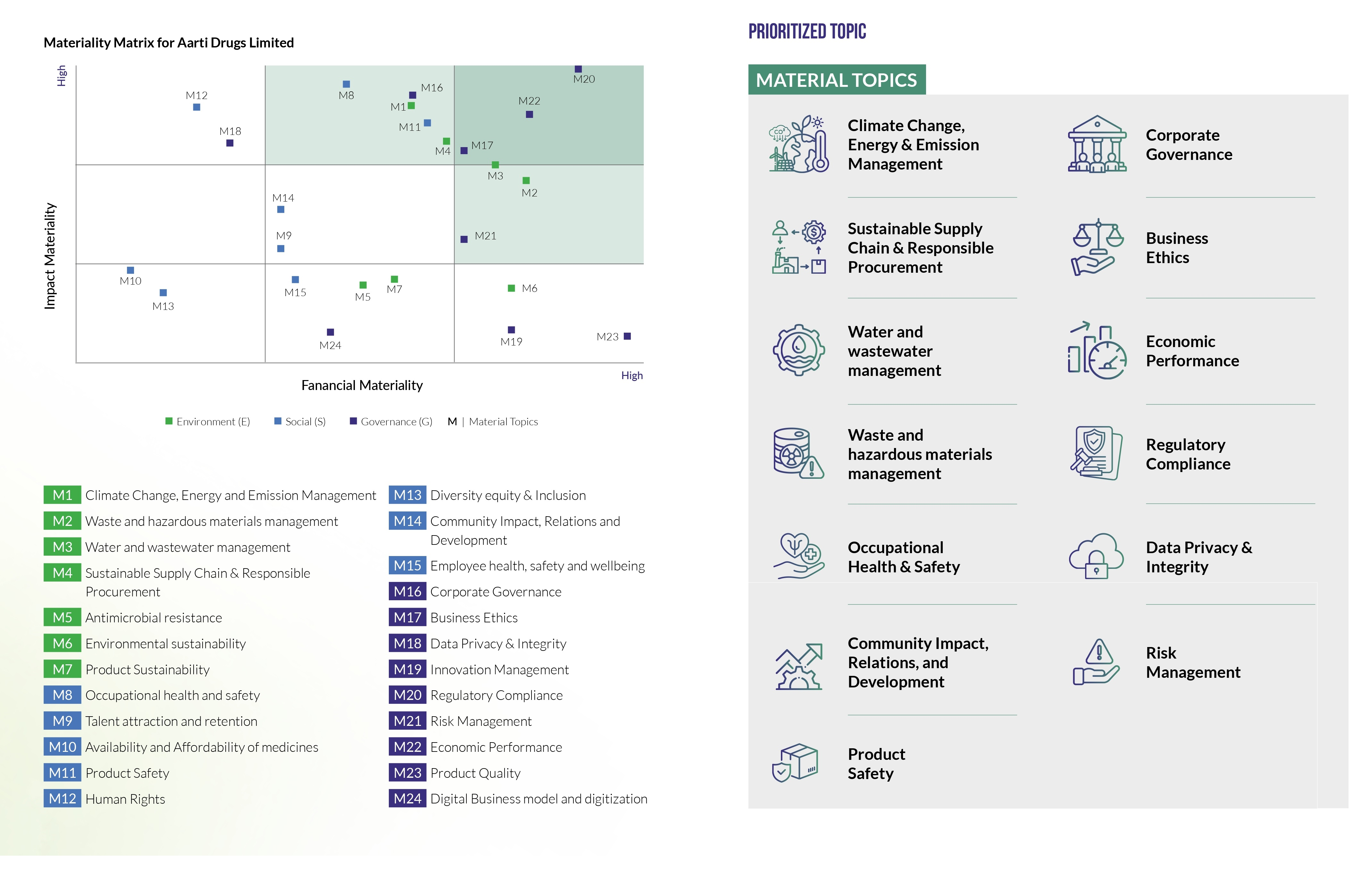
At Aarti Drugs Limited (ADL), sustainability is integrated into our core strategy - driving long-term value while contributing positively to the environment, society, and governance landscape. Our materiality assessment plays a central role in identifying and prioritizing the ESG topics that are most relevant to our business and stakeholders.
Purpose & Approach
We recognize that focusing on what truly matters - both to our business and to the planet - is essential for sustainable growth. Our materiality assessment process is designed to:
- Identify key ESG topics that significantly impact our operations and stakeholder expectations.
- Align sustainability priorities with our strategic vision and value creation objectives.
- Continuously adapt to emerging risks, industry trends, and stakeholder inputs.
Stakeholder Engagement & Methodology
Stakeholder Relations
Engaged with internal and external stakeholders, including employees, investors, regulators, and customers.
ESG Analysis
Analyzed global ESG benchmarks, industry best practices, and regulatory developments.
ESG Integration
Mapped ESG issues against ADL’s business strategy and risk management framework.
FY 2023–24 Materiality Assessment
In the financial year 2023–24, ADL conducted a comprehensive materiality assessment in accordance with the Global Reporting Initiative (GRI) 2021 guidelines. Our evaluation considered two critical dimensions:
- Impact Materiality: Assessing the effects of ADL’s operations on the environment, society, and economy.
- Financial Materiality:Understanding how external ESG factors may influence ADL’s financial performance, resilience, and long-term sustainability.
SBTi Commitment
We are currently in the process of evaluating our readiness for the Science Based Targets initiative (SBTi). Internal discussions and baseline assessments are ongoing to define realistic and measurable targets aligned with SBTi guidelines. We have collected three years of relevant data, and the process for formal commitment and validation is underway.
Renewable Energy
We have partnered with Prozeal Energy for a group captive solar project, expected to commence operations by October–November 2025. This project is projected to generate approximately 30 megawatts of renewable energy.
Scope-1 and Scope-2 Emission Targets
An internal target has been set to reduce Scope-1 and Scope-2 emissions by 20% by 2030, using 2020 as the baseline year. This reduction will be achieved through process optimization, energy efficiency improvements, and increased adoption of renewable energy sources.Additional Carbon Emission Reduction Initiatives- Enhancement of energy efficiency through process upgrades and equipment modernization.
- Optimization and improvement of solvent recovery systems.
- Continuous efforts at the molecular level, including:
- Monitoring and optimizing reaction stoichiometry.
- Reducing vent losses via advanced absorption and desorption techniques.
- Improving reaction efficiency and minimizing by-product formation to lower overall carbon footprint.
- Enhancement of energy efficiency through process upgrades and equipment modernization.
Chat on WhatsApp
closeHello! Need a quotation? Please share your details below.